on texture
BLUE HERON and the contours of a Pacific Northwest childhood

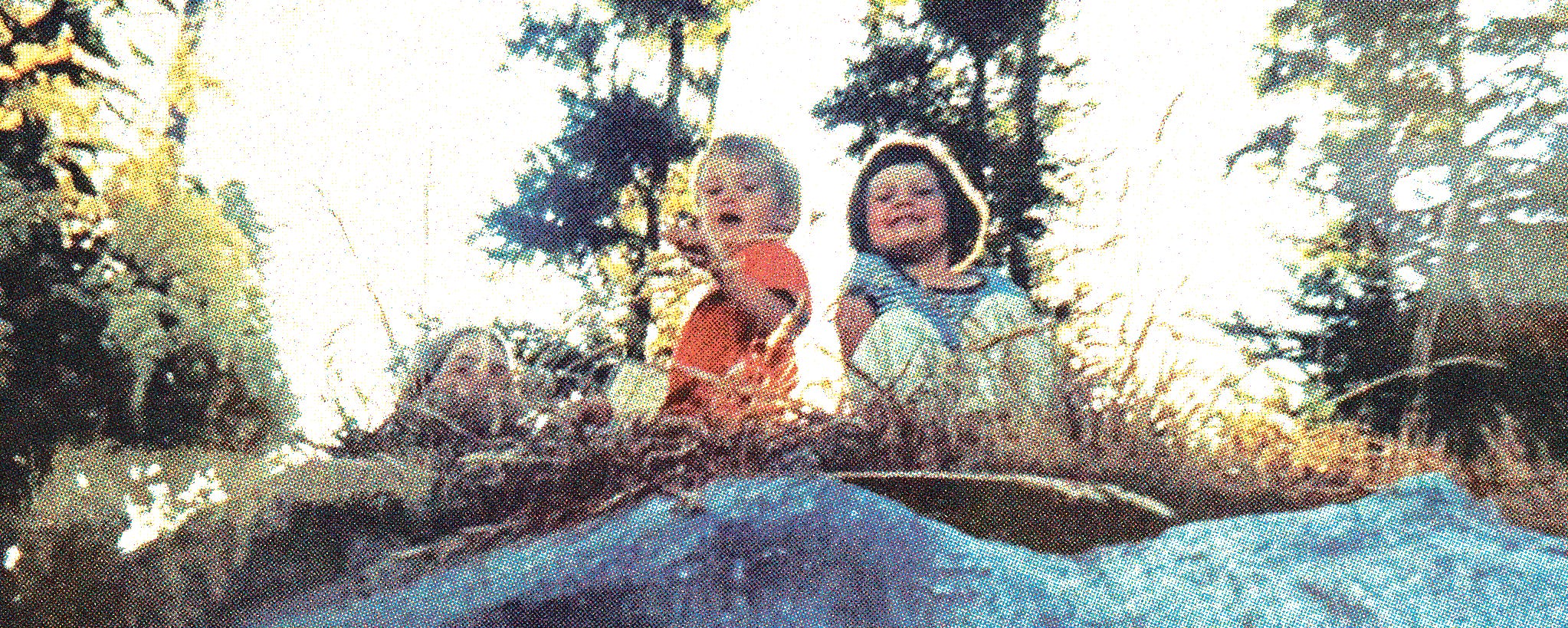
Spoilers for Blue Heron.
None of my friends out here know about hunting for shore crabs. I bring it up every so often, looking for a glimmer of recognition I haven’t found east of the Cascades. I tell them about the way everything scatters as you expose the puddle to gray sunlight. Shells that look purple or green against the pink warmth of your skin. How, with the right angle, you can overturn a rock twice the size of your five-year old head.
When Sophy Romvari’s fictionalized brothers overturn the rocks and gleefully pick up a crab shortly into Blue Heron, holding it up to the light and declaring it’s missing a limb, I’m already crying. I’ve been crying since the camera first swept over the bay, revealing the stacks of houses that shape the hills of a Pacific Northwestern port. I’ll keep crying with every rock and leaf that Romvari focuses in on, until the house lights come up, until I’m the last one in the theater. No more coats and no more home.
Every childhood develops a narrative in hindsight. I like to think my experience of this is a novel one; my own childhood can be reassembled by looking closely at my name. You can go to the library and pieces of it in the Memoir and Nature and Young Adult stacks (among others). There are so many versions of myself fixed in ink. It’s an especially intense variation on this theme, a metaphor made painfully literal.
This narrative distance can be useful. The facts feel concrete when I can hold up a physical object and point at them. One of these facts: I spent my childhood on a series of islands off the coast of Washington state. The northernmost, where I was at my youngest and most feral, was 20 miles from Romvari’s home (and shooting location) on Vancouver Island, just across the invisible border that splits the Haro Strait. I would return there for the rest of my life.
I can tell you about how it felt to walk these dirt roads with my siblings and comrades in childhood. I can tell you about the long nights spent around the firepit with my parents and their friends, gazing out onto the Strait of Juan de Fuca. I can choose whether or not you learn about the smell of weed drifting down from the forest, the way the adults are deciding with their eyes whether to say anything about it to the teenage boy in the trees. I can choose if you learn that one of these adults is the teens’ soccer coach, brought along as the grown boyfriend of a 15 year old. These details hang ominously outside the frame.
In the first half of Romvari’s film, each frame is delicately composed to obscure. We join Sasha, a young girl played by Eylul Guven, and her family at the moment they arrive on Vancouver Island, unloading their mattresses and eating a haphazard first meal among boxes and candlelight. A story is unfolding around the edges of the screen; Sasha’s mother frets on the phone to an unseen listener, and her oldest brother, Jeremy, shoplifts from gift shops.
The camera doesn’t linger on these moments, but instead weaves them into larger tapestries of the raw texture of childhood. The golden grass of a Northwestern summer, the shadows of leaves cast on pavement, the click of the bucket tool on MSPaint. There are other voices too; the actors playing Sasha’s younger brothers, Liam Serg and Preston Drabble, are especially adept at conveying the excited babble of true youth. When we do see the parents talking honestly to each other, it’s almost always through the house’s many windows and mirrors. These are a child’s glimpses, not an adult’s honest reckonings. They’re filled with the unease of partial information.
As Jeremy’s struggles slowly move center stage, so do the parents’ efforts to shape their family narrative. Sasha’s father is a photographer with a basement darkroom, and both parents capture the siblings in their happiest moments. While her mother attends a meeting with a child psychiatrist, her father photographs Jeremy dusting the boys with sugar, a rare expression of shared glee. We zoom in on Sasha as the shutter clicks, seeing the image imprint on her mind as something worth saving. The family troops down to the basement to print it, and one of the younger brothers gazes at the developing image in awe, asking “Who is that?”
Only so much of a narrative can be corralled, however. When Jeremy comes home in the back of a police car, Sasha’s father hands her the camcorder he was holding as he runs over to intercept them. Her awareness of the abnormality of their situation, what her mother calls “what is happening here”, can no longer be denied. She watches her father and Jeremy argue, then hug, through a basement window. The scene has the truth of memory, a genesis point for every calculated glimpse we’ve caught so far. When a social worker finally arrives at the family home, Sasha and all three of her brothers are watching Looney Tunes in their parents’ bedroom, sequestered from the domestic drama. Eventually, at last, she leans her head against the door to eavesdrop.
There is a moment when the narrative of your childhood becomes crystallized. For me, it was in these same northern islands as a young teenager. I opened my mother’s laptop to find an email from a friend, and instead found a piece of writing never intended for my eyes. I remember how I was glued to the faded couch on the porch, which still sits there today. I remember how I felt it in my gut. I never told her I read it.
Halfway through Blue Heron, Sasha’s mother’s phone calls finally have a voice on the other end: adult Sasha, played by Amy Zimmerman, now working as a filmmaker. The camera becomes still and formal as she soothes her mother and begins gathering the pieces of her own narrative in earnest. She convenes a panel of experts (all of whom are perfectly cast, blurring the autofictional lines with their sympathetic glances) and attempts to play writer and character all at once, explaining to them that she’s “a filmmaker here to present you with a case file”. She answers questions about Jeremy’s life, his hopes and dreams, as she adjusts the cameras. They process the details as she tells them, apologetic, “There’s a lot of confusion in the documents. But this is what we have.” There is tenderness in their responses, but even they seem to be able to tell she’s unsatisfied.
At home, Sasha has a Zoom call with the family social worker who visited all those years ago. It is here that the story of Jeremy begins to come together most clearly. Photos taken by Sasha’s father flash across the screen as the social worker tells her that Jeremy kept a can of gasoline in his room. He had threatened to burn the house down with everyone in it. It’s the kind of detail that snaps everything into focus. That you immediately wish you hadn’t learned, because you know it will color everything backwards forever. Sasha ends the call and cries into her palms, still and silent. We can glimpse a map of a cove on the wall of her living room.
In her 1977 book Holy The Firm, Annie Dillard chronicles a week in her life on Waldron Island, which lies just between Romvari and I’s childhood homes. In it, she describes the geographic peculiarities of the Salish Sea:
These mountains—Mount Baker and the Sisters and Shuksan, the Canadian Coastal Range and the Olympics on the peninsula—are surely the edge of the known and comprehended world. They are high. That they bear their own unimaginable masses and weathers aloft, holding them up in the sky for anyone to see plain, makes them, as Chesterton said of the Eucharist, only the more mysterious by their very visibility and absence of secrecy. They are the western rim of the real, if not considerably beyond it [...]
But the mountains are, incredibly, east. When I first came here I faced east and watched the mountains, thinking. These are the Ultima Thule, the final westering, the last serrate margin of time. Since they are, incredibly, east, I must be no place at all.
It’s this sense of no-place that’s evoked as Sasha’s realities merge, and she steps into the social worker’s shoes and crosses the Salish Sea to return to the pivotal site of her childhood. In an incredible shot, she stands on the top deck of her ferry home, dwarfed by the water that divides her past and present. It’s another moment of metaphor made literal. It would be too on-the-nose if it wasn’t true, a journey I myself have made only a handful of times since moving east. Sasha tucks a recorder in her purse and walks up to the front door of her childhood home, engulfed again by the trees.
As she steps into the social worker’s role, the camera takes in the home through adult eyes, in long and studied wide shots. Her parents sit on the couch and unfurl the full story of Jeremy’s troubles to her. Earlier in the film, child Sasha lies in her parents’ bed as her mother asks, more thinking aloud than anything, “Why do you think he’s like this?” Adult Sasha, unrecognizable to her family in her disguise, now poses the same question to her mother. As her mother answers, the camera slowly pans over until we’re seeing the parents in the mirror once again. The boundaries between parent and child, youth and adulthood, have fully collapsed. She pulls a notebook out of her purse, and reads them the narrative of the rest of their lives. It’s stark, clinical, the same way she was when meeting the experts. It ends simply and heartbreakingly: you will not save him. The story has been told.
Before their interview, Sasha wanders through the rooms of her childhood home, gazing at the full textures of her family’s life. Finally, she reaches the bedroom where her young self sits, in those last moments before her ear is glued to the door and she understands the full picture of her childhood. The two Sashas rest their heads together on the bed, giggling as they lock eyes. The older whispers something in the younger’s ear.
When you are young, all you want is to know what’s going on. When you are old, you are desperate to return to the time before you knew. You forget the fear, the way the story is tucked into every corner. When the two Sashas are together, they are in the no-place. They are west of the mountains. For a moment, anything is possible.
Even now, I am leery of narrative. This is probably the only thing I will write this year. I’ll put it on a Substack I’ve never posted on before and might never post on again. I keep asking myself, why do I need so badly to write about this movie? My life is full of incredible critics and journalists, and Blue Heron has been written about extensively and beautifully. Everyone has ghosts. So much of the brilliance of the film is in the way Romvari draws your eye to the details of your own childhood, pulling out the corners you prefer not to talk about.
It is unlocked for me when I’m watching Still Processing, Romvari’s 2020 documentary short. If Blue Heron is all mirrors and barriers, Still Processing is unbroken eye contact. Romvari’s father, like his fictional counterpart, was a photographer, and the scratched surface of his photographs of their family becomes the texture of the screen itself. We hear Romvari cry as she sorts through the photos on a lightbox. What she cannot speak or film, she writes at the bottom of the screen. It’s a pure exorcism of a narrative strikingly similar to Blue Heron; revisiting it after the film, Jeremy’s resemblance to Sophy’s own brother takes my breath away. Early on in the short, in response to an unheard question from her father, Sophy says “Kind of, but not really. I just don’t remember.” I want to reach through all the windows and mirrors separating us and say I was there too. I was a few miles away. I remember. You got it right. It’s a magic trick how much you got it right.
The cove where Sasha’s brothers hunt for crabs is, like so much here, familiar to me. It’s a protected inlet of childhood. The boundaries are clear, two rock walls that circle each side. Outside of the cove, you can run away from home or try to jump off the roof or hear things you don’t understand. Inside, the worst thing that can happen is a foot that threatens to crush your sandcastle before pulling away with a grin.
At the end of the movie, adult Sasha and an apparition of forever-teenage Jeremy, in the place west of the mountains again, return to the cove. They balance on top of the rock boundaries together, and the frames become layered with the golden grass and the Salish Sea. It all blurs together as Jeremy says, speaking for the second and final time in the film, “I think there’s a lot you don’t remember.”
When I’m done crying, when it’s just me and the girl sweeping up popcorn, I get up and rejoin the moviegoers in the lobby. I throw myself into the chest of my friend waiting for me. I don’t know what to say, so I say the only thing I can think, over and over. “She got all the textures right.”
("and there we go again"- seeing our narrative (so avoided) unwind- of and between the scope of the last time we time traveled and now)- thanks for sharing lou! will ever remember thos softly held crab-